Kiro AI
What if your IDE could truly collaborate with you, turning ideas into production-ready code with AI-driven precision?
Kiro is an agentic AI development environment that helps developers bridge the gap from AI coding to robust engineering. It manages intent, completes long-running tasks across large codebases, and validates code correctness with an agent that learns how you work.
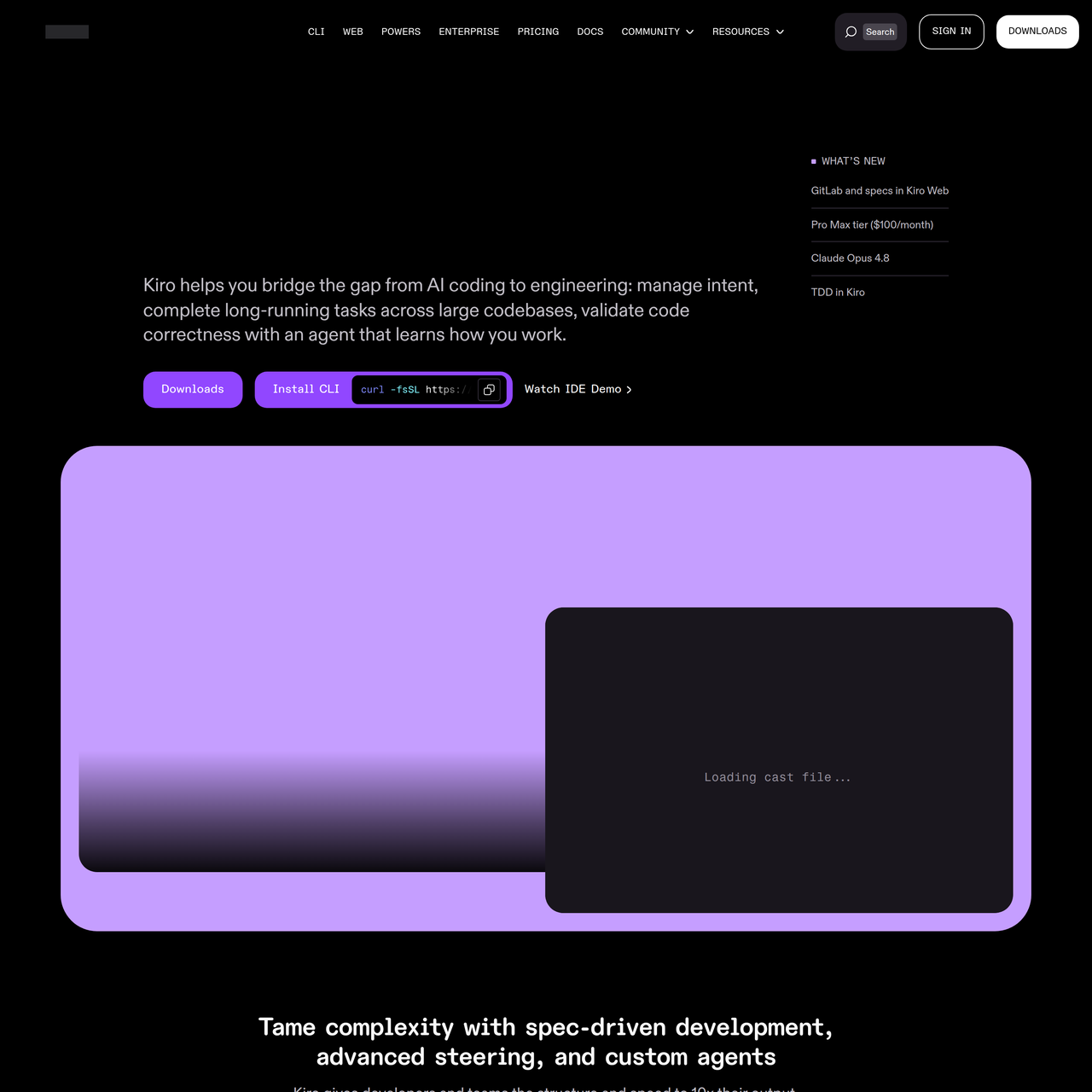
- Agentic IDE, CLI, and web interface
- Spec-driven development for structured AI-assisted coding
- Agent hooks for automating tasks (e.g., docs, tests, optimization)
- Support for a wide variety of programming languages
- Integration with external tools and data sources via Powers (MCP)
- Developers seeking to integrate AI agents into their entire software development lifecycle.
- Teams looking for a structured approach to AI-assisted coding, moving beyond 'vibe coding'.
- Engineers who want to automate repetitive tasks like documentation, unit testing, and code optimization with AI hooks.
- Pricing for GovCloud regions is approximately 20% higher.
- Unused monthly credits do not roll over.
- Team billing and management features are coming soon, currently subscriptions are per individual user.
- Free: 50 credits, open weight models & Claude Sonnet 4.5
- Pro $20/month: 1,000 credits, premium models, pay-per-use overage ($0.04/credit)
- Pro+ $40/month: 2,000 credits, premium models, pay-per-use overage ($0.04/credit)
- Power $200/month: 10,000 credits, premium models, pay-per-use overage ($0.04/credit)
Founded
2026Team Size
small
AI Model
Auto (mix of frontier models like Sonnet 4.5 and specialized models), Claude Sonnet 4.5, Sonnet 4.6, Haiku 4.5, Opus 4.5, Opus 4.6, Opus 4.7, Qwen3 Coder Next, DeepSeek v3.2, MiniMax 2.1
No
Name
Kiro (built and operated by AWS)
Kiro is an agentic development environment built by a small, opinionated team within AWS, aiming to reinvent how developers work with AI agents and integrate them deeply into the software development lifecycle.
What is Kiro and how does it help developers?
Kiro is an agentic AI development environment (IDE, CLI, web) that helps developers move from prototype to production by turning prompts into detailed specs, working code, docs, and tests. It uses AI agents to manage intent, complete long-running tasks, and validate code correctness, learning how you work.
What is spec-driven development and why is it important for Kiro?
Spec-driven development, as pioneered by Kiro, involves defining requirements, system design, and tasks with AI before writing code. This approach explicitly documents reasoning and implementation decisions, allowing Kiro to handle more complex tasks efficiently and avoid misinterpreting context, which can be a limitation of 'vibe coding'.
What are 'Powers' in Kiro and how do they work?
Powers are specialized contexts and tools that add expertise to Kiro agents on-demand. They encapsulate best practices from dev tool providers and domain experts, steering agents for specific use cases. Users can find or create powers, install them with one click, and Kiro dynamically activates relevant ones based on conversation context.
Which AI models does Kiro use?
By default, Kiro uses 'Auto', an agent that combines various frontier models (like Sonnet 4.5) with specialized models for tasks, intent detection, and caching. Users can also choose to exclusively use models like Sonnet 4.5, Sonnet 4.6, Haiku 4.5, Opus 4.5, Opus 4.6, or Opus 4.7, as well as open-weight models like Qwen3 Coder Next, DeepSeek v3.2, and MiniMax 2.1.
Can I import my existing VS Code settings into Kiro?
Yes, Kiro is based on Code OSS, so you can import your VS Code settings, themes, and Open VSX compatible plugins during the Kiro onboarding flow.
- Developers seeking to integrate AI agents into their entire software development lifecycle.
- Teams looking for a structured approach to AI-assisted coding, moving beyond 'vibe coding'.
- Engineers who want to automate repetitive tasks like documentation, unit testing, and code optimization with AI hooks.