Semantic Scholar

Tired of information overload in scientific research? Discover a smarter way to navigate the vast world of academic papers.

RecommendedSemantic Scholar leverages advanced AI to transform scientific literature discovery, offering powerful tools like TLDRs and 'Ask This Paper' to combat information overload and accelerate research.

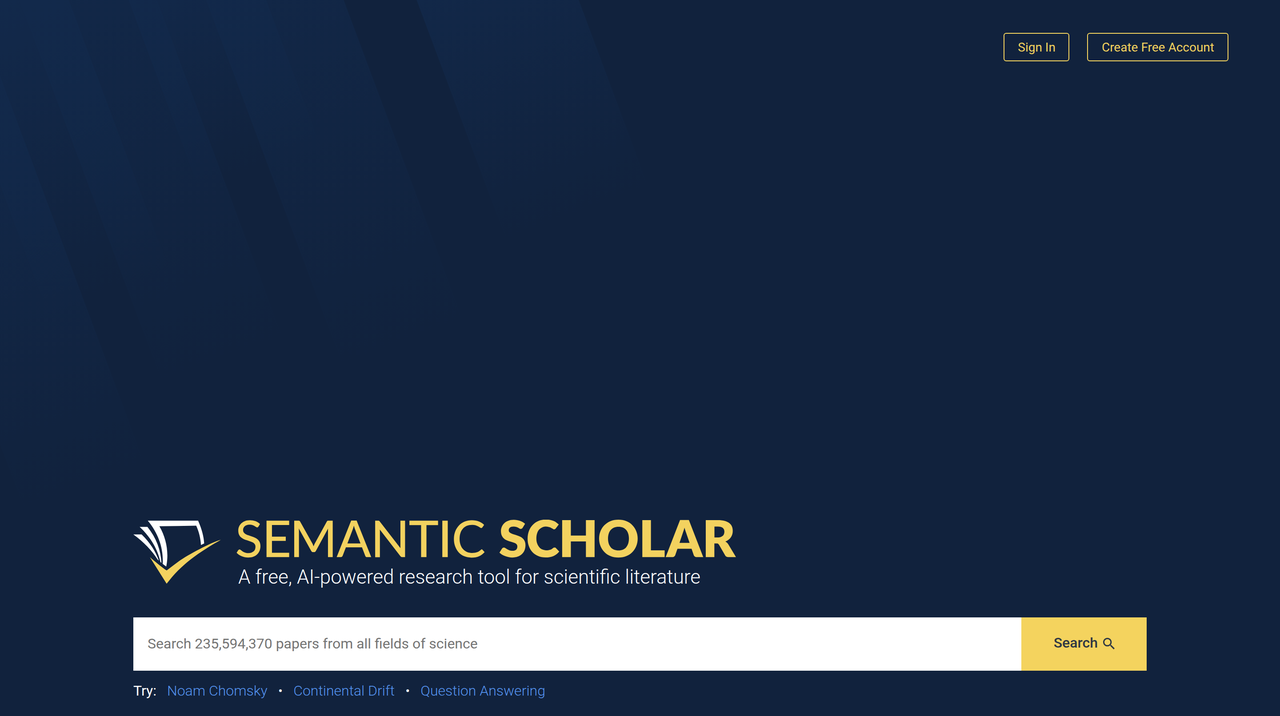
Semantic Scholar is a free, AI-powered research tool that helps scholars discover and understand scientific literature. It uses machine learning to extract meaning, identify connections, and surface insights from over 200 million academic papers, aiming to accelerate scientific breakthroughs.
Key Features:
  • AI-powered search and discovery of scientific literature.
  • TLDRs (Too Long; Didn't Read) for quick paper summarization.
  • Highly Influential Citations to identify key works.
  • Personalized Research Feeds for paper recommendations.
  • Generative AI features like 'Ask This Paper' and Topic pages.
Pros
  • Researchers overwhelmed by the volume of scientific literature.
  • Academics seeking to quickly grasp the core concepts and impact of papers.
  • Developers looking for programmatic access to scholarly data for building new applications.
Cons
  • Generative AI features may contain factual inaccuracies or awkward phrasing.
  • Some advanced AI features like Topic pages are currently limited to specific fields (e.g., Computer Science).
  • Does not provide permissions for using, publishing, or distributing parts of papers; users must contact authors/publishers directly.
Pricing
freeFree tier
Starting at:Free
Share:
Quick Decision
Try if: You should try Semantic Scholar if you are a researcher or academic looking for an efficient way to discover, understand, and stay updated on scientific literature, especially if you appreciate AI-powered summarization and contextual insights.
Skip if: Skip if you require absolute factual certainty from AI-generated content without any need for verification, or if your research needs are strictly outside the scientific literature domain.
Not for: Individuals seeking a general-purpose search engine for non-academic content.; Users who prefer traditional, manual methods of literature review without AI assistance.
Trust Signals
  • Founded


    2015
  • Users


    8M+ scholars globally
  • Team Size


    medium
Notable Customers
LitmapsConnected PapersStateoftheart AISourcelyYomu
Tech Details
Platforms
webapi
Integrations
Zotero
  • AI Model


    gpt3.5-turbo-16k (for Ask This Paper), LLMs (for Topic pages)
Open Source
No
Support
Channels
emailFAQ
Company
  • Name


    Allen Institute for Artificial Intelligence (Ai2)
  • Location


    Seattle, WA, USA

Ai2 is a non-profit research institute founded in 2014 by Paul Allen, with the mission of conducting high-impact AI research and engineering in service of the common good.

FAQ

What is the advantage of using Semantic Scholar over other academic search engines?

Semantic Scholar is a free, AI-powered search and discovery tool that uses machine learning to extract meaning and identify connections from scientific literature. It surfaces these insights to help scholars gain an in-depth understanding quickly, aiming to accelerate scientific breakthroughs and overcome information overload.

Does Semantic Scholar offer programmatic access to its data?

Yes, Semantic Scholar provides programmatic access to its data through the Semantic Scholar Academic Graph (S2AG) RESTful API, downloadable S2AG datasets, and the S2ORC general-purpose corpus for NLP and text mining. These resources support high-impact research and engineering.

What are TLDRs and how do they help researchers?

TLDRs (Too Long; Didn't Read) are AI-generated summarizations for scientific papers that help researchers quickly determine the key aspects of a paper. These extreme paper summaries are an alternative to abstracts, designed to help researchers navigate and understand scientific literature easily and efficiently. They are currently available for computer science and biomedical domains.

What are the benefits of creating a Semantic Scholar account?

Creating an account allows users to create email alerts for new papers, generate research feeds for personalized paper recommendations, save papers to a library, and claim an author page to manage author details and papers. While an account is not required to access papers, it enhances the research experience.

What should I be cautious of when using generative AI features on Semantic Scholar?

Users should be aware that text generated by language models in features like 'Ask This Paper' and Topic pages may not be free of errors, including factual inaccuracies, awkward phrasing, or irrelevant information. It is recommended to verify the accuracy of generated text whenever possible.

Use Cases
  • Researchers overwhelmed by the volume of scientific literature.
  • Academics seeking to quickly grasp the core concepts and impact of papers.
  • Developers looking for programmatic access to scholarly data for building new applications.
AILookup

Research utility for AI tools. Compare reviewed profiles, distinguish listed tools from reviewed coverage, and track tool changes without marketing fluff.

© 2026 AILookup. All rights reserved.